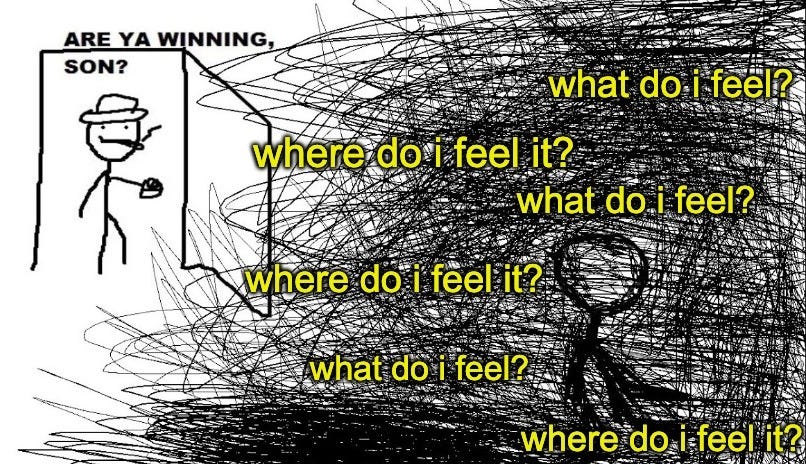
You can logic your way out of multiple situations in life and convince yourself of a lot of things – and NGL, it works remarkably well and is healthy – but there are situations where the body knows better, and I’ve been slowly exploring what that looks like. Knowing when to listen to the mind and when to listen to the body is perhaps the real balancing act, not so much this reconciliation or suppression of one over the other as the situation dictates. Your nervous system kinda does know it all, and is perhaps the best indicator of what you reallyyyy need in life.
This isn’t to say I’ve been numbed to the sensation of “feelings” in my body before this. Although, it has been new territory the past half-year, sort of like learning a new language and trying to cross-reference words in the language you’re already familiar with (the “languge of the mind”) with the other (the “language of the body”). There’s an eventual unification or mental restructuring that takes place, in the same way reducing the angle between two distinct vectors gets them to point in the same direction (☝🏻🤓) – and I see that unified direction as what you really need in life. I’ve observed myself balance the two much better now, but of course, it’s a WIP. And no, I can assure you this isn’t a case of “guy discovers somatic therapy”. I’m also not going to over-intellectualise it here (I promise).
Listening to your mind and body require different approaches to the same question of “what am I comfortable and safe with?”. Perhaps, in trying to understand and regulate myself better, it’s happened as a nice side-effect – but now, I’ve been thinking about it a lot more while learning to become more chill with life.
Like what you’re reading so far? Subscribe to hear me yap about more stuff like this!
There is no hierarchy
For a long time, I was a strong believer in “mind over body”. It made sense at a high level: from Shaolin to Hinduism, there was some emphasis on the mind being able to control the body and what it wants – but over time, I’ve slowly moved towards the “mind and body” camp.
This seems like a very, very, very obvious moral-of-the-story, but you should definitely come to that conclusion after experimenting with it a bunch: you should see how far you can go before eventually realising your mind shouldn’t do so much heavy-lifting in the first place, and needn’t be ridden so hard. I’m definitely the over-thinking type, not out of anxiousness (very little of that, at least) but some level of perceptiveness, so it’s been helpful to offload quite a bit of processing to what my body wants instead of giving everything some tangible “form” through words and thoughts. A good friend has a cute slur for times when I wordify things too much: “Rishabh, stop being a pedant”, short for pedantic.
I used to do Tai Chi in 2022 but gave it up because it no longer served any purpose for what was on the top of my mind then; although, it was very helpful and I’ve brought it back into fashion now in my life. With the somatic stuff, I tried it extensively the past half year in my own time, especially with a ton of things that gave me existential angst (work, relationships, school, hobbies, etc). Closing my eyes and asking myself “what do you feel?” and “where am I feeling it in my body?” were simple ways to start. The answers were pretty simple and child-like: is it a tightness in the chest, or a tingle in the shoulder, or a sharp sting in the gut, or a bubbliness and tipsiness in the arms? Trying to connect with my so-called inner child, and using only words he would use (ie, colorful adjectives) was the move but was pretty difficult at the beginning.
What DOES the body say?
As with all things adjective-related, your mind needs to give it meaning. You need to associate these sensations with what it really refers to in your context. In many ways, it’s pretty similar to “moving on” and being able to hold the past easily without it causing any random, unexpected crash-outs. I think a lot of people conflate “moving on” with forgetting, and sure, that’s helpful. But any reminders of the things you forgot will give you the same angst as opposed to actually sitting with the emotions and damping them over time.
When starting out fresh, it was this weird Uncertainty Principle: when you try to “measure” a sensation in your body associated with some event or person or experience or thing, the sensation goes away quickly, but when you stop and just feel, you know it’s there and where it’s taking your thoughts. It’s fleeting and only exists insofar as your will to feel it rather than explain it and what it means to you as soon as possible. There’s always this tendency to want to get to the bottom of why you’re feeling something about something, but impatience here came with the usual annoyance of the feeling disappearing the more you tried to force it into existence in your body.
I played Cricket all through middle school in Singapore and it was super fun! When learning how to catch the ball when it was so high up in the air, in my enthusiasm to make the catch, I’d force the ball into my hands, causing clumsy drop-catches (or pretty nasty lacerations on the palm …).
Instead, it was more natural to allow the ball to fall into your hands gracefully, and to let your hands follow through with the residual motion of the ball until it stopped.
My middle school cricket team after a game in the rain. Spot me.
Getting better at somatically understanding myself felt very much like that. Sports metaphors aside, it wasn’t about forcing the feelings to take shape, but to follow through if and when they arrived – and I get why it’s so mentally exhausting for those who go through somatic therapy sessions.
(I’m pretty sure you can also come up with a tennis and fishing metaphor for this.)
It does get easier with time and practice, and it certainly helps to have someone close guide you through it by asking you simple questions like “what do you feel?” and “where do you feel it?” when you’re thinking about something that gives you angst.
Don’t overthink following the compass
There’s a huge trap in believing you need to be super profound with how you describe how you feel to really get the answer you’re looking for. It’s been hilariously humbling to find out you need to keep it as simple as possible. It’s also fascinating to realise it was never really about finding answers but to identify sensations and reduce their physical impact/influence over time. Sure, that seems like an “answer” in and of itself, but that’s just being a pedant.
Perhaps the biggest outcome of all this is to live with low angst.It’s about lowering the volume of the mental fuzz that exists as unnecessary background noise.
There is no big revelation or big answer at the end. Only, you being more chill and feeling safe about whatever’s causing your angst.
In my other post, I talk about sōphrosynē1. This is exactly what such a somatic practice tries to give you.
Something else that’s equally nice to realise is that much of this isn’t about understanding myself better from a “I prefer X over Y” perspective, but to quite literally be comfortable in my own skin – to become bulletproof in some way, not because you’re over-protecting yourself but as some proof that I can remain unaffected by the things that once felt like punches to the gut (or wherever your body says so, lol).
It’s so easy to use words, ideas, concepts, and literally anything that’s a non-feeling to describe the sensations. I used to get so caught up trying to think of funky adjectives to describe these sensations when all it required was a first-grader’s vocabulary to give it some form. It was an uphill climb to shut off the inner yapper and use something as simple as “I feel X-feeling in Y-bodypart”. It was so easy for my mind to think, explain, justify, and shape-rotate, but it’s been fun trying to get better at this magical other thing.
I think knowing yourself well enough through words is a precondition but is insufficient to be good at cultivating a healthy somatic relationship with your body.
Discerning Genuine vs Fake
As someone who believed the mind has quite some control over the body (it kinda does), I was always curious about my feelings towards things being genuine (or not) and whether I really cared about certain things (or not) that I’d get sad about or would give me angst.
One of the best realisations was that genuine feelings come with a great deal of somatic sensations, which helps discern real from fake. The body will tell you when you’re really feeling something, and whether you really care about something, and this comes in the form of those sensations in different parts of the body (the sting, tightness, throbbing, etc). This is really helpful in identifying what in your life is important to you based on the physical and mental feelings they elicit. As you get better at holding things from your past, it really is about what and whom you feel safe around, about, and with.
It helps to distinguish situations when your mind genuinely feels something towards something OR intentionally makes you sad about something to give yourself the false impression that you’re capable of remorse, regret, guilt, and other things that cause angst2. It’s very meta, but the compass of somaticity is the best tool you have, and in many ways, it’s helped me rest easy knowing that the things, people, and experiences I genuinely love and care about are what give me the highest-magnitude sensations (in my chest, heart, etc) when I think about them and the angst associated with losing them or existing in tension with them.
Just feel bro …
Someone I knew well a while back, whom I’d think was pretty knowledgeable about this stuff, introduced me to the concept and I never thought much of it at the time after trying it once or twice, but it’s refreshing to have given it another go for real. I now have a newfound respect for those who engage in anything somatic. It is really mentally exhausting but is super helpful in the long-run.
Liked what you read? Subscribe to hear me yap about more things like this!
Sōphrosynē is a Greek word for a state of inner harmony that allows you to moderate the impact of the things happening around you or the stuff you experience. This also holds for your interactions with people, things, and ideas.
I realise the mind has many ways of tricking you into believing you’re sad or regretful towards something when you probably don’t really care about it as much as you think you do. It gets very meta, so I’ll stop right here.